Monday, 22 December 2014

One person's relief is another person's burden

In an article in the Jamaica Gleaner on December 19 titled "Restore Junior Market Incentives To Spur Growth", reporter Avia Collinder presents Jamaica Stock Exchange (JSE) head Marlene Street Forrest's views on the need to retain the tax incentives offered to companies that list with the JSE Junior Market.

Street Forrest says “the Junior Market incentive drives small and medium-size companies to list”. The question I would like answered is, what benefit is derived by the economy as a whole from these companies receiving preferential treatment? If the Junior Market fails to attract listings purely because of the withdrawal of the tax incentive, then doesn’t that raise the question of what benefit listed companies enjoy, other than the tax incentive?

It seems to me that’s the question that the JSE should be seeking to answer. If the only way I could get a new customer to buy insurance was by giving away a tank of gas, I really, really need to re-examine the value of the product I’m selling.

Street Forrest’s argument as presented in the report rests almost solely on the basis of examples of listed companies that have had good results, or increased productive capacity. This is a specious argument, because:

  • This is likely to be a biased sample. Only well-managed companies (whom we expect to out-perform their competition anyway) are likely to qualify to list. It does not follow that listing causes better performance.
  • Even if listing does lead to better performance, you need to isolate and discount the benefit derived from the tax incentive, otherwise you have proved nothing about the benefit of listing other than the incentive.
  • Rather than hand-selected anecdotes, I would like to see an economist’s quantitative analysis of the relative performance of listing versus remaining private, alongside a qualitative assessment of the non-tax related benefits (and let's not forget to account for the costs that result from non-incentivised companies having a higher tax rate to pay for the fortunate few).
Every tax incentive that is applied selectively has the potential to give advantage to one group at the expense of another. Governments should only consider such arrangements when an overwhelming case can be made that the result is a significantly positive effect for the economy as a whole, and not just for the advantaged group.

Thursday, 25 September 2014

Sales or Service - A Genius's Perspective


There's an interview with two Apple Geniuses that I read recently at Yahoo.com

As most of you probably know, Genius is Apple's name for the support guys ​in the Apple Store who help customers with problems that they are having with their devices.

The whole interview is interesting, but there were a couple of things that really caught my attention:

Tim: When you are a Genius, you are sent out to Apple corporate for three weeks of training. The first week is basic troubleshooting. The second week is all customer interactions, how you should talk to them and listen to them. I think that’s the most important part. The third week is when you fix devices.

Greg: Training is much more focused on how to position information and ask questions. There’s lots of asking permission, being empathetic, and trying to align with people. So, you’re not just saying, “This is broken. It costs this much to repair.”​

 ​It is clear that Apple spends a lot of training time emphasizing how the Geniuses talk to customers. I think that's because they understand that while you can look up technical issues in a manual, communicating effectively is something that you have to know how to do. And if you don't Apple teaches you.

The second pair of comments that caught my eye was:

Greg: I find that one of the reasons people tend to like the Genius Bar is that we’re honest. If you don’t need a new OS upgrade, I’ll tell you.

Tim: Your job isn’t meant to make money. Your job is to make sure the customer leaves knowing they can have complete trust in Apple.​

That last one in particular is pretty powerful. It is such a clear statement that the relationship with the customer is worth more than the value of a single transaction.

Sunday, 22 June 2014

Goals and randomness at the World Cup


All those reporters theorising about the reasons for the plethora of goals in the 2014 World Cup should stop comparing only with "the last world cup" which happened to have the 2nd lowest goal per game average ever (2.27 to 1990's 2.21), and is 20% lower than the overall average. Against that overall average, 2014 is running at close to par. Admittedly the average was 4.25 from 1930-1958, and only 2.57 from 1962 on. So 2014 is running about 12% higher than the 'modern' average. (I'm getting these stats from a very nice visualisation put up by The Economist)

This could just be randomness. I just flipped a virtual coin 100 times at random.org. The first 10 flips had 8 tails & 2 heads. The last 10 had 6 heads & 2 tails.

Proving?

Sweet fanny adams. Just like all those articles.

Saturday, 14 September 2013

Your nightmare is my ho-hum

By the time an insurance claims handler has spent 5 years on the job, he or she has repeatedly seen and dealt with a variety of scenarios. Customers who are clearly legally at fault, yet who cannot accept it; third parties who accept responsibility at the scene of the accident and then can't be found; people who buy a car and think they can drive on the seller's policy without telling the insurance company; losses from lightning hitting a car or customers blithely driving their high-end sedans into (but seldom out of) waist-deep water.

The natural human response is to become blasé and matter of fact. When you figure you've heard and seen it all, it's really hard to see things the way the customer is seeing it. We forget that our 5000th claim, that we already see following the patterns laid down by the previous 4999, might easily be this customer's first such experience. One result is that it is harder for us to display the level of empathy that the customer so often needs from us. 

A few years ago I took a call from an unhappy claimant. He'd been in a three vehicle collision in which he was clearly not liable, but the insurers of the other two cars were blaming each other. He was naturally upset because while that dispute was crawling to (hopefully) some resolution, he was significantly out of pocket. I had experienced a very similar situation a few years ago, that only resolved when I sued, and won, in RM Court. I decided to share my personal story with the customer, while at the same time setting out an approach that we could take that had a chance to move things along a bit quicker.

The change in the customer's mood was instant. Of course what he ultimately wanted was to have his claim paid (so it was important that I addressed his issue at the same time that I was telling him my own story), but he also needed someone to acknowledge the unfairness of the situation. To show  empathy, and validate his anger and frustration.

That's the element of customer support that gets overlooked when we define our roles in mechanical, task-oriented terms. In a competitive market, we absolutely need to be efficient with turn-around times and following up the process. But that's hygiene. We really create distinction when we recognize and take into account that we are dealing with customers who are navigating unfamiliar territory, while worrying about background stuff like: how am I going to get my kids to & from school while the car is laid up; where am I going to find the money for the deductible; how much is my renewal premium going to increase because of this accident?

It's a nightmare scenario, during which the customer encounters what they perceive as the blasé, seen-it-all-before claims handler, writing letters in formal office-lingo designed to mask any trace of personality, delivering bad news via tersely worded emails, casually treating with issues that represent terrifying outcomes for the customer. And it's not that claims handlers are bad people. They are human, and this emotional detachment is entirely predictable based on human psychology.

Knowing this, we have to make an effort to avoid it. We have to define customer-support as delivering what the customer needs. This includes but cannot be limited to the service that we are legally contracted to deliver. It must also extend to offering empathy, emotional support, advice, or whatever else we can. The only way we will be able to do so effectively is by developing the skill of getting out of our own heads, and trying to imagine ourselves in the customer's predicament. Even if we start out not being all that good at it, I'll bet that the customer will see and appreciate the effort, and that by itself will be a valuable upgrade to the level of service that the customer experiences.

Sunday, 26 May 2013

Leading Means Following

A couple of months before I started working as a CEO, I saw a television interview that was very timely for me. It was on the American news magazine '60 Minutes', with USA's then Chairman of the Joint Chiefs of Staff, Admiral Mike Mullen.

Mullen talked about a congratulatory letter that he received when he was promoted to Admiral. In it was a line that had driven his approach to leadership. It said "Congratulations. Just remember, from now on…you'll always eat well, and you'll never hear the truth again."

Mullen's response to that piece of advice was to spend 30% of his time travelling to far flung US military posts, talking directly to the front line troops. I'm sure he knew that the 'truths' that he was hearing from the troops weren't necessarily any less subjective or self-serving than the ones he heard from his Pentagon staff. But they would have been different ones, and would have helped him to form a more complete picture of what was really going on.

Just having face to face conversations with different groups isn't enough though. For this tactic to be effective, the leader has to be careful not to lead the conversation. People react to power by giving it what they think it wants. That's a rational, if often unhelpful, behaviour.

I was lucky enough to have spent a few years working with a CEO who was extraordinarily mindful of this dynamic. Whenever there was a group discussion in the context of a decision to be made, he very consciously held his own views back, and would go around the table asking each person, however junior, what they thought. I remember on a number of occasions being on the spot on a matter about which I didn't have a well-formed view. I felt the way you do in an exam at school when you have exhausted your knowledge about a topic but are still 100 words or so short of the required length.

But the individual's comfort level is secondary (if it's a factor at all). The process more often than not forced people to crystallize and express a view, and with the spotlight on you, the desperation to say something often brought out useful views that would have otherwise remained buried.

This way of operating is a lot harder than it sounds for most CEOs. People who get to leadership positions are often what DISC analysis refers to as 'High Ds'. That's D for Dominant. It's only by consciously fighting that innate tendency to dominate that a leader can maximize value from those around them.

Monday, 25 March 2013

Let the chips fall…


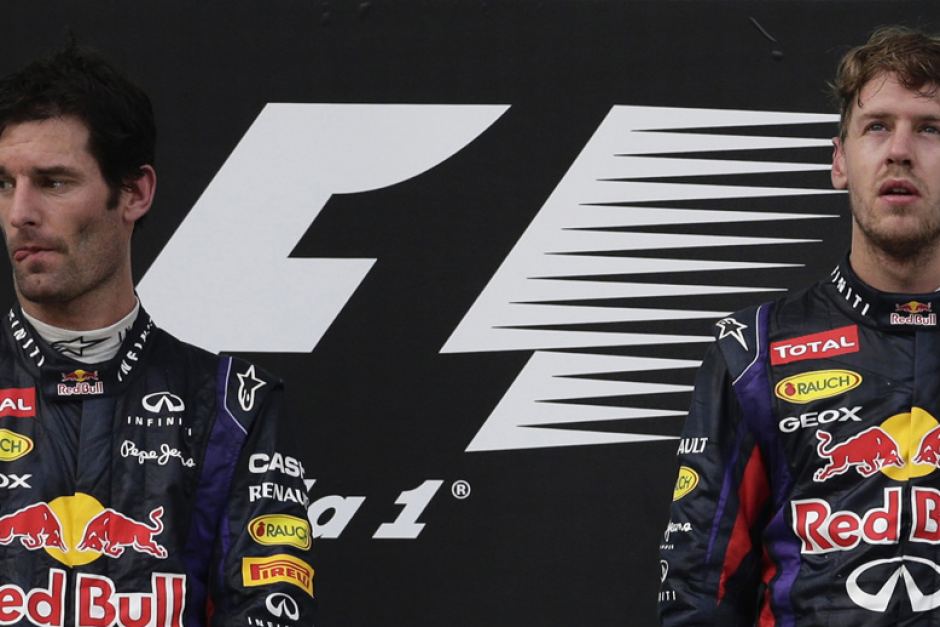
There was a collision between the world of Formula One and my world of management this weekend. At the Malaysian Grand Prix, the Red Bull team that has won the constructor’s championship for the past three years found itself, not unusually, coming out of the last round of pit stops with its cars running first and second. What was unusual was that their three-time world champion, Sebastian Vettel, was in second place, with veteran Mark Webber leading.

Within the team there was a prior agreement between the drivers and the team management that they would not race each other after the final pit stop. Up to that point, it was hammer & tongs, but once they got to that last stop they would “settle” in position and ensure they brought the cars home safely.

The agreement was reinforced by a team radio instruction to bring the cars to the finish in their current order. Webber turned down the settings on his engine, going only fast enough to ensure that the gap between the Red Bulls and the Mercedes in third was maintained over the last dozen laps. Vettel had other ideas. Ignoring the agreement, and the radio instruction, he set about taking first place off his teammate.

It may well be that Vettel would have been able to pass Webber even if no team orders had been issued. But as it was, Vettel was racing, and Webber wasn’t. So it’s no surprise that Vettel was able to overtake and ended up winning the race. Webber was a very unhappy and angry race driver during the podium ceremonies.

The body language speaks volumes. Webber's on the left (duh).


The part that interests me is something that team boss Christian Horner said after the race. In an interview he said that Vettel knowingly did what he did, and when asked why the team did not order Vettel to give Webber back the place that he had ‘unfairly’ taken, this was Horner’s reply, "Do you honestly think that if we had told him 'slow down and give the place back', he would have given it back? There was no point. He had made it quite clear what his intention was by making the move. He knew what the communication was. He had had the communication. He chose to ignore it.”

But Horner is wrong. Not in his assessment of what Vettel’s likely reaction would have been to such an order, but rather in his statement that there was no point in giving the order. Before we go any further, I need to say that I’m going to ignore the issue of PR & spin here. I’m well aware that Horner will not necessarily be saying the same things in team meetings as he is saying in an interview. But for the purposes of this blog, let’s just take it at face value.

By saying that there was no point in ordering Vettel to let Weber back in front, since he wouldn’t have done it, Horner is the one who misses the point. It’s one thing for Vettel to breach the agreement in the heat of the moment. But it would have been quite another thing to refuse an order from the team boss. And even if Vettel had taken that option, the team would at least have gained from Webber knowing that they had done everything they could to support him. As it is, you have one driver who is a loose cannon, and the other feeling cheated AND let down by his team.

I see this a lot. People abandon the right course of action because they think they know what the outcome is going to be, and maybe are afraid that it will lead to having to make a difficult decision. Supervisors with a chronically late employee stop giving feedback, instead of escalating the issue. Sales representatives mentally bail out of negotiations because they think the customer has already made up his mind. But we don’t know the future. The supervisor doesn’t know whether the escalation of the issue will lead to an unpleasant confrontation with the employee, or to the situation turning around. The sales rep doesn’t know for sure whether the customer has made his decision, and even if he has, doesn’t know what building the relationship with the customer might lead to in the future.

I think some of it is due to insecurity - if you don’t try, you can’t fail (not true of course - if you don’t try you guarantee failure). Sometimes it may be due to fundamental attribution error (thinking that someone behaves a certain way because that’s who they are rather than because of the specific context that they are in). Whatever the pathology, it’s a terrible way to make decisions.

You have to do what’s right, and let the chips fall where they may. Often the way they fall can be valuable information that guides you in the future.

Wednesday, 6 March 2013

Management Judo


I faced a slightly testing situation this week at work. A client needed something from my company. This client is a sister company in the same group as my company’s major shareholder, and we have common board members.

The same day that the request came in, the client’s CFO emailed one of those board members to ask him what he could do to expedite the request. He in turn forwarded it to me.

Effectively, she went over my head. My ego was bruised. I was not happy.

As soon as I received the email, I drafted a response to the board member responding with a status update. I also added a deadpan, but undeniably snide comment to the effect that the CFO could have gotten the same information from me had she simply asked.

Then I put the email in my drafts folder, telling myself that I would decide in half an hour whether I still wanted to send it. I ended up letting it sit overnight.

When I came back to the issue, I realized that had I sent it I would have been guilty of the same thing that had pissed me off – I was complaining about her to one of her directors.

I also realized that this was a very time-sensitive issue for her and she was trying to pull out all the stops to do her job. Yes, she was thoughtless in how she went about it. This could have been because the urgency caused her to overlook the niceties, or it could be because she’s simply one of those people who don’t have a strong sense of empathy (I know lots of them).

But at the end of the day her intentions weren’t important. What was important was to solve her immediate problem, and also to improve our relationship.

So I deleted the draft, and emailed the CFO directly. I gave her a status update, explained why this particular process was necessary, and gave her my best estimate of when we’d be ready for her. And I told her she could call me if she needed. 

It’s not that I’m not still irritated with she did. But that is done and I can’t change the past – I can change the future though. The best way to avoid this happening again is to make sure I’m her first port of call when there is an issue. And the best way to do that is to make it more efficient, effective, and pleasant for her to come directly to me.

So that’s what I tried to do. Whether it’ll have the desired effect, I don’t know. A lot of management is about doing and saying the right things and then hoping that it has the desired effect.

More often than not, it does.

Thursday, 28 February 2013

Don't Be An Asshole


Some of the dialogue around issues of racism and bigotry is infuriating and infantile.

People who say “[insert minority] are hyper-sensitive”, or “Political Correctness is bullshit and inhibits communication”, what are you really thinking? What right are you so determined to exercise?

Imagine you meet someone and a debate arises on the merits or otherwise of the death penalty. You might wonder why that other person is so strident and seems to have such a personal stake in things. And imagine that when you deliver your reasoned, logical, copiously well-informed argument against the death penalty, the other person bursts into tears. You might think, reprovingly, “Don’t be so emotional”.

But wouldn’t you also disengage from that topic of conversation, knowing it is so upsetting to someone else? Even if you thought that person was being ridiculously sensitive, would you press on regardless?

And if it comes to light that the other person’s context is that they lost a loved one to violent crime, would you ignore that and continue with your unassailable argument? If so, you are an asshole.

Don’t get me wrong. You have a right to be an asshole. You are legally entitled to ignore people’s feelings, and their specific contexts, and to continue being an asshole.

But why would you want to? Who sets out to be an asshole, and then loudly proclaims that other people have no business telling you not to be an asshole? No one that I want to hang with.

If using a term to describe a group of people causes some members of that group anguish, or pain, or anger, and you keep doing it regardless of what you know of that group’s history of marginalization, deprivation, or torture at the hands of established society, then you are an asshole.

Don’t be an asshole.


Sunday, 7 August 2011

Guest Post: A review of Rise Of The Planet Of The Apes by Damian Levy


Before beginning the review I would like to say that I for one welcome our ape overlords as our superiors and am more than willing to be their human slave if they deem me worthy.


That being made clear, this is a spoiler-free review for "Rise of the Planet of the Apes" which may be seen as a prequel to the 1968 Charlton Heston movie "Planet of the Apes" but can also be seen as the first in a new series but with the same concept. That being said the movie doesn't fail to please fans of the original like myself with nods and refrences. I won't give them away as being a fan of the first it's much more fun to pick up on them for yourself.

Now a word to the aforementioned fans of the original. You may feel like you can't trust that this movie will be good because you've been burned before as evidence by the terrible remake in 2001. I can assure you this movie will not disappoint as the spirit of the original is ever-present here yet still feels like a whole new experience.

The movie opens up with chimps running around in the jungle, as chimps do, being pursued by poachers. Shortly after we see what some of the apes are subjected to which is animal testing at Genisys a company devoted to the development of experimental medicine. Here we are introduced to Will, played by James Franco. Will is the head of the personnel devoted to the development of the cure for Alzheimer’s.

Will is a sympathetic character if there ever was one. A man trying to cure the world of a disease, for which there is no approximate cause, which causes an unbearable burden to the loved ones of those with it. This Will knows first-hand as his father suffers from the disease and is slowly deteriorating. It's admirable to see Will as a character that doesn't do what he does for the tired motivations of money or fame but instead for men like his father and to a greater extent families of those with the disease whose suffering is also great. It's a remarkable backstory which provides a great care for the character.

The problem is he's the only human character in the film.

Aside from will the only other people in this are not characters but plot devices. You have the insensitive business man who writes the cheques so that Will's project stays alive but who is only in it for its potential profit. You have the love interest to give Will perspective on the consequences of his actions which his passion might blind him to. And of course Tom Felton plays Draco Malfoy. The characters lack of development is appropriate though as the attention that would be used on well-developed side characters is brought towards the development of James Franco's character Will Rodman who by the end of the film is much more understood as far as who he is and what he is all about and feels known by the audience. More on that in a bit.

Now while there are no other well developed human characters there is another well-developed character, Caeser the ape played by human actor Andy Serkis through motion capture animation. Every facial expression and tidbit of personality exuberated by Serkis is captured and animated into a computer generating ape. This is done extremely well but forsakes realism in the design of the apes as they look computer generated which doesn’t bother me in the slightest because even if it looked like a real ape I would know it was fake. Caeser is different from your everyday ape as he has an enhanced intelligence due to the experimental drug administered by Will. As a result of his enhanced intelligence Caeser lives as a human does with Will and is treated in a way which will help him reach his full potential. This establishes a family relationship among the three characters namely Will, Caeser and Will’s father and not only are they a family but they are a happy family. In the first act of the film there is a montage of 3 years of happy times where the love and care the characters have for one another is shown in spades. It’s heartwarming stuff and it comes into even more effect as the movie goes on.

Of course it can’t all be cures for horrible diseases and happy families can it. The conflict can be said to have begun when Caeser starts to get existential and wonder if he is a pet or if he and Will are equal. He learns of his creation and the reasons behind it. Serkis’ performance particularly shines here as he portrays what it looks like to have your world shattered almost effortlessly and it is believable and the audiences heart sinks. The conflict moves even further when Caeser is deemed too violent to be in a suburban home due to his excessive defensive nature and is court ordered to an animal shelter. This is a crucial scene as it reminds the audience that though Caeser is gentle with Will and his father and though he may have an enhanced intelligence and though his violence is for the best intentions, he is still an ape and they are very dangerous.

Then of course comes the Shawshank Redemption-esque scenes where Caeser is in a prison essentially surrounded by dangerous non-enhanced intelligent apes and Caeser becomes scared. Caeser now faces a trifecta of trauma and that’s aside from his realization that he is a walking test subject. He has been ripped away from his family, he is surrounded by dangerous apes and he is being tortured, and that word is not used lightly, by Tom Felton. I forget his character’s name. so of course Caeser snaps and begins his revolution.

The film is blatant in its arguments against animal cruelty and testing brining to the point that many animals sent to be tested on are put down if the drug fails and many animals sent to animal havens are severely mistreated. Now is the movie saying that this will result in world domination by animals? No but it’s definitely not ruling it out

The mistreatment that all the apes suffer makes them sympathetic to the audience as their pain is understood and it can be seen as a reasoning as to why they are so violent towards humans and why they feel the need to revolt. However the Apes do some damage to many random humans even a few fatalities which then turns the creatures you once sympathized with to be creatures you now fear. It’s very difficult to find a clear antagonist or a protagonist here.

By the end of the film you wish for more and it feels like the beginning in a series. You want to see what happens with Will and Caeser who by the end of the movie are not as likeable as they were however they are still understandable characters. In terms of action there was a gripping 3rd act of non-stop action which made me want to be a gorilla for what that’s worth. I give the movie 8.5/10 stars. Would have been more had the movie not been so dismissive of its side characters and the movie feels like it was held back because it was trying to get a PG-13 rating so the really horrifying stuff that would have made this excellent leave it being great.On a final note, I have to say Will was asking for it, not just for creating a supersmart ape but for naming him Caeser. You have to appreciate the irony of that.

Monday, 14 February 2011

Time travel

I celebrated a birthday last week. Not just any birthday, the end of a lustrum, which as Judge Parker explained to Rooster Cogburn, is a five-year period. As a result I had the pleasure of spending my birthday morning renewing my driver's licence.


While I was there, working on the morning's crossword, I heard a metallic "CLA-CLACK", that I knew well but suddenly realized I hadn't heard in years. I looked up to see a man holding a hard-shell Samsonite briefcase, with those spring-loaded locks that were the source of the familiar sound.


And it struck me how old-fashioned it looked in his hand. I ruminated that the world has moved to back-packs and messenger bags and laptop cases, and that this leather-coated one-time staple of the corporate warrior has become an anachronism.


Which, big deal, right? But this next realization I mostly owe to Nicholas Bate, a remarkable business blogger who has a regular bit on stuff that has changed over time (I emailed him the idea of doing one on the briefcase, so if you see it on his blog it's not because one of us is stealing from the other). What hit me was that up to the "CLA-CLACK" moment I had no conscious idea that briefcases were obsolete. Until I was confronted with this relic of the past, I was completely unaware that anything had changed.


So of course now I'm wondering, what else has changed, that I'm unaware of, and will remain unaware of until my next time traveling episode?

Thursday, 2 December 2010

The Dawning Of The Age Of Assange?

I find myself with little sympathy for the various government officials expressing outrage over Julian Assange's release via his Wikileaks website of the US State department cables containing secret communications between US diplomats and their governments.

Yes I know Hilary Clinton among others have said that lives will be lost as a result. But still I find these protests unconvincing. Let's face it, government officials are completely invested in the current ways of conducting the affairs of state. Clay Shirky said "Institutions will try to preserve the problem to which they are the solution." This is the aggregate effect of the phenomenon described in Upton Sinclair's statement that "It is difficult to get a man to understand something, when his salary depends upon his not understanding it!"

So the fact that the US' Secretary of State is alarmed by the thought of letting more sunlight into the diplomatic machinery is neither surprising nor persuasive as to the actual merits of Assange's desire to let the sunshine in.

In fact some of the strident defending of the status quo sounded like what I imagine members of the aristocracy might have said about the concept of democracy when those troublemakers Voltaire and Rousseau started going on about individual rights and self-determination. It must have been unthinkable to a member of the nobility that the nation's future was going to be in the hands of the unwashed & uneducated masses.

Clinton said hyperbolically, "This disclosure is not just an attack on America — it's an attack on the international community". Well, I guess it's an attack, but I'd say it's an attack on subterfuge and secrecy. And secrecy itself is arguably an assault on democracy. It's a safe bet that had transparency existed around the 2003 debate over the invasion of Iraq things would have played out differently.

One of the interesting revelations from these cables is that it seems possible that China is not so committed to defending the Kim Jong Il regime in North Korea as we have been led to expect. China has shown hints of being willing to live with a Korea unified under the current South Korean government & system. If this is true it opens up the question of whether the US needs quite the military presence in South Korea that it currently has. I have no way to come to a sensible opinion about that question, but I am pretty sure that the debate is different with the possibility of an ambivalent China rather than a fiercely committed one. And if it weren't for Wikileaks I'm reasonably confident that we wouldn't have had a clue about that possibility. Governments that want to maintain high levels of military activity will not be keen to entertain discussion that will lead to a reduced sense of peril among it's constituents.

If an intransigent China poses a problem to which increased US influence is the solution, then it will be difficult for those in the halls of power in the US to do anything but preserve that problem, and if that means portraying China as more intransigent than they really are, so be it. There are a lot of salaries dependent on failing to understand any other reality.

Thursday, 14 October 2010

How Jamaica should be more like Switzerland

I was having lunch with a business associate from Switzerland the other day. He told me that the German that is spoken natively in his homeland, known as Swiss German, has no written form. Their written language is "High German", as he called it, also called Swiss Standard German. High German can be understood by non-Swiss German speakers. Swiss German can not.

Swiss German is spoken in all but a few contexts - the classroom (though not the playground - not only do the schoolkids use Swiss German on the playground, but so do the teachers); in multi-lingual parliamentary sessions; on the main news broadcast; and in the presence of German-speaking foreigners. There are many formal contexts in which Swiss German is the norm, such as business meetings, and court testimony.

He didn't say this (it would have been un-Swiss to say it out loud) but it seemed clear to me that the use of Swiss German was a matter of pride, and perhaps an important differentiator for the Swiss people.

Somehow it didn't seem important that his native language was not a written language. Nor that, as he admitted, Swiss German speakers are usually far less fluent in High German. Nor that their language was not intelligible to German-speaking foreigners.

It hasn't crippled their economy to have a native language that is unknown outside their borders. There is no social stigma associated with the use of Swiss German.

It has its place, and High German has its place, and that's all there is to it.

I can only wish that the same will one day be true for Jamaican Creole.

Monday, 11 October 2010

Management Lessons From The Road

I recently travelled to London via Miami. I flew American to Miami and British Airways to Heathrow.

While I was waiting for the agent in Kingston to check me in, I heard him asking his colleague what happens if they are checking in a code-share passenger when the second airline involved has a more restrictive baggage allowance than American. For instance, American allows two checked bags free, but Delta only allows one, and charges $27 for the second.

Although it didn't apply to me and my one bag, it was obvious that checking me in had triggered the question. And neither my agent nor his colleague knew the answer. I talked to them about it, and neither could recall the question ever being addressed in their training.

When I arrived at Heathrow I was waiting for the driver who was supposed to pick me up. I called the car company and they put me on to him. He was in the airport and so we had to agree where to rendezvous. I was standing under a large banner hanging straight down from the ceiling identified the area as the Northern Meeting Point. "That's a great idea." I thought, as I relayed this information to the driver.

He'd never heard of the Northern Meeting Point. "Can you see the Costa Café?" he asked. I could. It was 20 yards away from me, and I made my way over there, found the driver, and off we went.

What is the point of these episodes? I think they exemplify two of the pitfalls that face those who make decisions that then have to be acted on by others.

In the first case, the code-sharing arrangement created a practical difficulty that the agents did not know how to overcome. Either the system designers failed to recognize the issues that could arise, or they failed to communicate the solutions to the customer-facing agents.

In the second case, the well-intentioned banner seemed to be largely ignored. My driver, who presumably regularly does airport pick-ups, had no idea that there was such a thing as the Northern Meeting Area. The truth is, the café was a far more obvious landmark than the banner.

With respect to the code-sharing issue, it's not just a matter of failing to provide the correct training - involving people at various levels in the design process, with their different perspectives, is just good practice. A system that taps into the wisdom of crowds (link to James Surowiecki's excellent book), has a much greater chance of being robust enough to survive contact with the real world.

And the question of whether, and how, to provide landmarks at the airport would be best addressed by incorporating input from those whom the solution is intended to benefit. Perhaps there are particular areas of the airport that do not have readily identified landmarks, and that is where some signage should be posted. Or perhaps people will inevitably find their own way, and in reality the banner is a solution in search of a problem.

It's really pretty simple: as much communication as possible, as early in the decision-making process as possible.

Monday, 12 July 2010

The Best World Cup Final In Decades

I’ve already heard expressions of disgruntlement about the world cup final. It wasn’t exciting; not enough goals; why is the third place play-off always so much better.

I couldn’t disagree more. I watched a thrilling final. There is a view, somewhat fed by lazy sports journalists, that goals=excitement. I do not share that view. The fact that the ball does not end up in the net does not invalidate an intricate, creative build-up, or a telepathically-engineered combination of perfectly-timed run and sublimely-weighted through ball that gives the defender no chance.

It is special when a brilliant move is rewarded with a goal. But to put so much store by the result seems a shallow way of thinking about the game. This final was a battle between two distinct ways of thinking about football, and, maybe, life.

It was clear that the Netherlands were going to come at the Spanish as they did Brazil – pressing all over the field, not allowing the Spanish time on the ball to settle into their possession-based domination, chipping away with tackles and fouls to ensure that no rhythm could be maintained.

Meanwhile Robben would do his thing, running at the defence whenever he had the opportunity, or Sneijder would take opportunities from outside the area, whether in open play or from a set piece. But it was always going to be based on winning the ball and making a quick counter-attack.

Spain, of course, would look to do what they have done for the past three years. Short passes, Busquets-Xabi Alonso-Xavi-Iniesta, probing for weakness, waiting for the defence to lose first patience, then shape. Which would allow room for Pedro or Villa. For variety, throw in some Pedro runs, and Ramos’ streaks from defence, and rely on Piquet and Puyol to guard against the counter.

And here’s the interesting thing about that match-up. In many ways, it's ass-backward.

In the mythology of the World Cup, The Netherlands teams of the 70s are not only the best team never to have won the World Cup – they are also the doomed romantics. The inventors of Total Football, defeated by the pragmatism, if not cynicism, of the German machine in 1974, and swept away by 80,011 Argentines in 1978 in the belly of the junta.

It would be unthinkable for Johann Cruyff, in the public’s eye the spiritual father of Total Football (and with those initials, who else could it be?) to express the sentiment as Dutch star Arjen Robben did that they would be happy with an ugly win.

He couldn’t even bring himself to support his nation’s team in this final. “I am Dutch but I support the football that Spain is playing.”

Cruyff is one of those directly responsible for the football that Spain was playing. Not as the distant inspiration of a team separated by national borders and three generations of footballers, but as an adopted son of Barcelona, and as the most celebrated pupil of former Ajax and Barca coach Rinus Michels.

It was Michels who took the gospel of Total Football from Ajax Amsterdam to Barca, where Cruyff also spent many years as player and then coach. Cruyff won the European Cup as Barca’s coach, and one of his players then was their current coach, Pep Guardiola. Guardiola of course is also the coach of six Spanish starters in the World Cup final (Villa doesn’t join Barca until next season).

Through that lineage, Spain’s team is made up of apostles of the 1970s Netherlands. while the current Netherlands team have heretically abandoned the faith, and now invest their aspirations in the darker arts (per van Bommel and De Jong).

So one of the questions that we knew would have a significant effect on the outcome of the final was: How much latitude is referee Webb going to give the Dutch? It became clear very early that he was mindful of the danger of practicing laissez faire in a contest between such fundamental forces, with such a prize at stake (with even Brazil practicing the counter-attacking game, if Spain lost would the world ever again see a team employ possession and creativity as their basic building blocks?).

So the yellow card came out early and often, with a nod to even-handedness, and a crystal clear sub-text directed at the Dutch.

They read it loud and clear, and for me one of the remarkable things about the game from then on was how effectively the Dutch were able to defend against Spain’s domination of possession given the early foul trouble. I was actually about to say that out loud when I got distracted by Heitinga’s sending off.

The Netherlands did have a little help from Webb, who apparently didn’t want to decide the game with his whistle (at least not 28 minutes into the game) and so refrained from giving De Jong a straight red for his karate kick to the chest of Xabi Alonso (who by the way was completing passes at an 86% success rate before the foul, and could only manage 63% for the rest of the half).

It became pretty clear, pretty early, that both teams meant what they had said in the build-up. There would be no foxhole conversions in this battle. Or to switch metaphors, they were gonna dance with the gals they brung (even if, as in the Netherlands case, the gal was ugly!)

So there was a lot of play in midfield, with the Spanish short passes working through the middle third, probing, trying to break down the Dutch. And the Dutch had 8 or 9 players behind the ball much of the time. And I guess that doesn’t sound too exciting, but I was on edge watching Spain try to pick the lock; watching Xavi bring the ball forward from Busquets, envisioning the first move in the sequence that would set the strikers free; watching substiitute Jesus Navas make the runs down the right with such enterprise against the tiring Dutch legs. And equally on edge watching the Dutch trying to defend, knowing that with one defender and three defensive midfielders on yellows, they were walking a tightrope on a gusty day.

Finally, in the latter stages of the second half, and throughout extra time, Iniesta stepped up, finding incisive passes that always seemed to trouble the defence, forcing corners & throw ins, putting Fabregas in one-on-one.

When Navas made another spearing run but this time, instead of taking it all the way down for the cross as he had so many times, as if just remembering that he was playing Spanish football he suddenly turned towards the middle of the pitch. There he laid it on to Iniesta, whose magical back-heel helped work the ball over to the left, somewhat flatfooting the Dutch.

By the time it ended up with Torres playing the ball in from the left, Iniesta had made his way to the right of the goal area. This time when he found the ball at his feet there was no mistake about what needed to be done. A match winner with 3 minutes to play in extra time is a pretty good resolution in my books.

Would it help if we pretended that Ramos’ early header scored? And that Robben chipped over Casillas on the one-on-one, and then Villa’s point-blank effort found goal instead of being blocked away by Heitinga’s left boot, followed by Ramos’ second headed goal of the game, and call it 3-1 to Spain in regulation? Would it have been a better match then?

Not for me. I’m fine with the match that I saw. Apostles 1, Apostates 0.